
Schools · Illinois · Wisconsin
Practical control for the people who run a campus.
This page is for administrators and staff. You need a way to handle a physical crisis that protects students, protects personnel, and can be explained afterward.
School staff are often asked to manage a moment they were never given a complete method for. Without early control, the pressure is to rush: get the student down, get the hands hidden, get it over with. That rush is where people get hurt and where the story of the event gets worse.
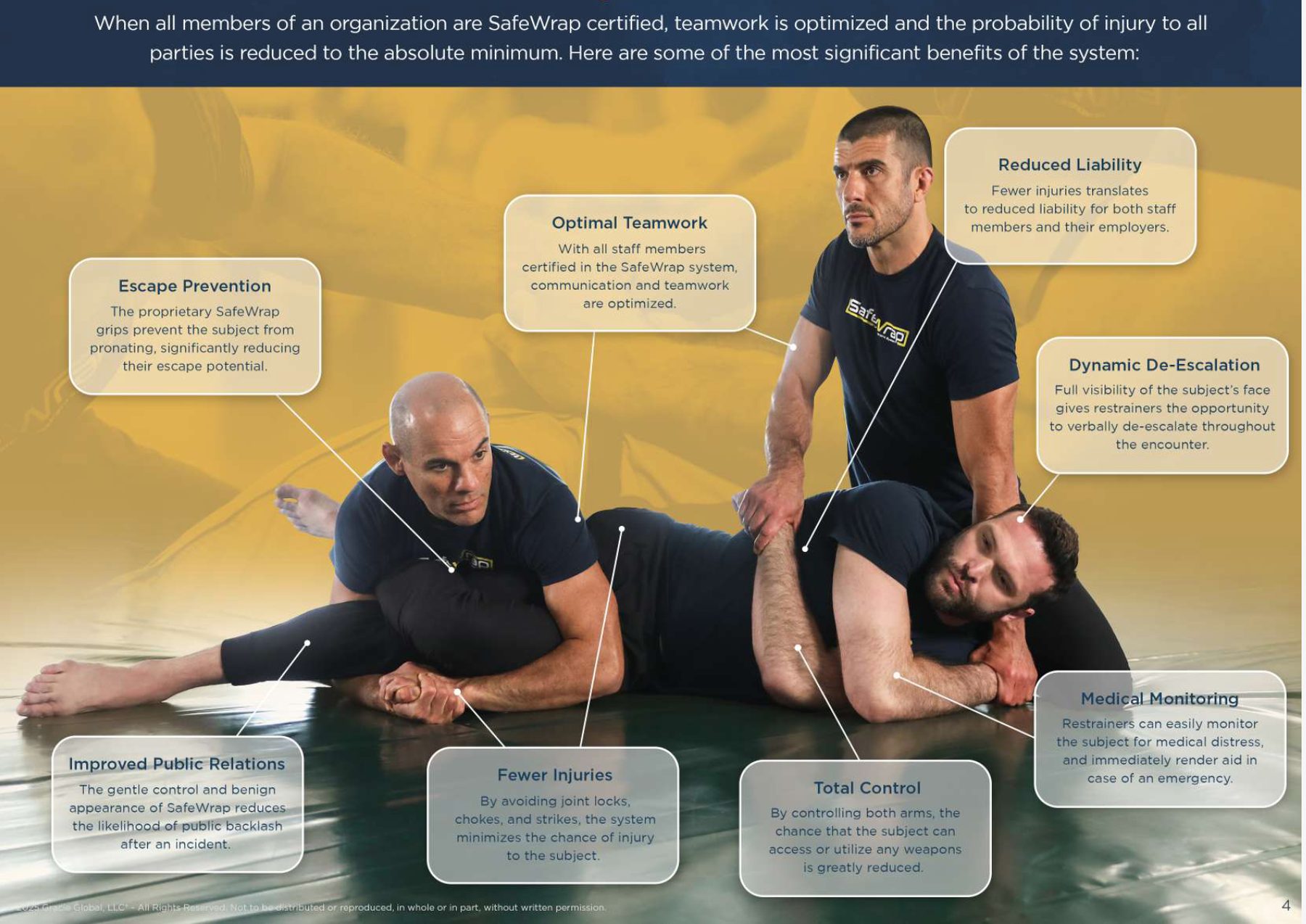
SafeWrap gives the room a different order. De-escalate and establish control. Then communicate. Then transition. The student is lateral, so pressure is off the chest and back, the airway can be watched, and the face is part of the conversation so de-escalation can continue throughout the process.
A sequence staff can trust
A crisis in a school happens in front of other students. Staff need to keep the chaos contained with a sequence they already know, so they are not deciding what to do in the moment.
Students stay visible
Lateral positioning keeps the face available. Staff can talk to the student, watch breathing, and avoid a prone pile in a hallway or classroom.
Less risk on both sides
No joint locks, no chokes, and no strikes. The goal is control that reduces injury to the student and to the adults responsible for them.
Measured, not rushed
When wrist control, movement control, and a weapon check are early, staff are less likely to accelerate just to feel finished.
Illinois RTO
Prone restraint is off the table.
Illinois schools answer to the rules for physical restraint, time out, and isolated time out. ISBE calls that RTO. The text is 23 Ill. Adm. Code 1.285. ISBE’s summary is here.
Imminent danger only
RTO may be used only when a student’s behavior presents an imminent danger of serious physical harm to the student, staff, or others, and only by staff trained that year in its safe use. It is not discipline, punishment, convenience, or a way to stop property damage when no one is in serious danger.
Prone is prohibited
Holding a student face-down and applying pressure to keep them there is prohibited in every circumstance, including when it appears in an IEP. Chemical and mechanical restraint are also prohibited, aside from the narrow exceptions written into the rule.
Eight hours, every year
Any adult who supervises time out or takes part in a physical restraint needs at least eight hours of developmentally appropriate training each year. Staff may use only the techniques they were trained in, and no one may use RTO before that training.
SafeWrap is a lateral hold. It is not a prone finish, and it does not use joint locks, chokes, or strikes. The face and the airway stay available. CTC does not replace a district’s RTO policy, parent notice, documentation, or the full annual training ISBE requires. It is the physical method we teach inside the line the state already drew. Confirm the current text with ISBE before it is written into a procedure.
Wisconsin, reported to DPI
Thousands of restraint incidents.
These are the 2024–2025 figures, the latest full year Wisconsin DPI has published. About half of schools reported zero incidents. The rest were spread across a majority of districts. The totals move year to year. They stay large. Schools report the data themselves, so the real count can be higher. School and district files are on the DPI seclusion and restraint page.
- 5,195
- Seclusion incidents, involving 1,880 students. About 80 percent of those students have disabilities.
- 6,043
- Restraint incidents, involving 2,708 students. About 78 percent of those students have disabilities.
Wisconsin law requires parent notification, a written report, a staff meeting after the incident, an IEP review after repeated incidents for a student with a disability, and an annual report to DPI. Prone restraint is prohibited. Staff have to be trained. Students with disabilities carry most of the incidents. That is the same pattern a documented, least-restrictive method is meant to change: de-escalate first, and restrain only when nothing else has worked. The same concern is covered on the vulnerable populations page.
How the training lines up
Built around the same priorities both states already name.
De-escalation first
Staff practice recognizing a situation early and resolving it before restraint is considered. That is the order both states expect.
Only what the States allow
The methods stay inside what Illinois and Wisconsin allow. Prohibited techniques, including a prone finish, are not part of the course.
A record that can be explained
Training includes how to capture the events and the interventions tried first. In Illinois that record is Form 11-01 and the student information system. In Wisconsin it is the parent notice, the written report, and the report to DPI.
Trained staff, not a one-off
The curriculum covers crisis de-escalation, trauma-informed practice, and behavior management, the elements Illinois names in 23 Ill. Adm. Code 1.285(h). Wisconsin requires trained staff before a restraint. In either state, the training has to stay current.
What a school keeps.
- Fewer restraint and time-out events.
- Staff who can show that less-restrictive measures were tried first.
- Documentation that holds up to a parent, an ISBE inquiry, or later review.
- Less of the claims and insurance impact that follow a restraint.
- A practical piece of the RTO reduction plan a district has to keep.
- Expert witness support from Gracie University Master Instructors if litigation follows a SafeWrap restraint.
The room is general education and special education staff, administrators, deans, security, and anyone who may have to step in when a student is an imminent safety risk. It can be taught on site, on a schedule that fits the district.

Certified

The cost of a claim.
A serious restraint or seclusion claim is commonly $250,000 to $1 million. Milder cases settle in the tens of thousands. A severe one, or one with a large fee award, can pass $1 million. The number the public quotes is the check. The district also pays its own lawyers. In a disability or civil-rights case, the other side’s fees can be larger than the settlement. Then the renewal comes, and the file has to be explained.
- A public vote to settle, with the parents already notified.
- Defense costs, and sometimes the plaintiff’s attorney fees on top of the payout.
- A harder insurance renewal. Education insurers have seen average claim costs roughly double, and losses of $2.5 million or more are showing up more often.
- Training, monitoring, or staffing written into the agreement. Some of those deals have cost districts millions.
- Administrators and staff pulled out of the building for months. The reputation cost is not on the invoice.
The pattern is already public. Wake County paid $450,000 after a special-education high school student was restrained and secluded. Sequoia Union High paid about $400,000 of a $560,000 settlement after a student was pinned down and arrested. Clark County approved $1 million after school police pulled a student to the ground near a high school. Moreno Valley paid a family $1.2 million, then was ordered to pay more than $5 million in the plaintiff’s attorney fees.
Illinois often requires willful and wanton conduct, not ordinary negligence, for a supervision claim. That limit does not cover an improper restraint, an injury, or a civil-rights or disability claim. One avoided claim in that range, plus the defense and the insurance that follows it, costs more than training the people who would have been in the room. Fewer incidents reach a board agenda. When one does, there is a record of what was tried first.
Plan it around the people who would be in the room.
Tell us the roles involved — administrators, security, student support — and we will shape a discovery conversation around them.